
DISCRET 11
DISCRET 11: Video encryption from 1984
The circuit is based on the pirate decoder from Radio Plans magazine, 1984. This decoder permitted to watch TV shows from a quite famous French TV channel without paying, with the help of some specific ICs and some reflexion. It was based on two video delay line, a sync signal extractor and also a delayed/nondelayed line detection circuit.The original encryption working by delaying lines of the picture pseudo-randomly (with fixed delay times), Radio plan circuit was checking if the line was delayed or not, and with the 2 onboard delays, realign the lines of the picture to make it viewable. A Wikipedia page about this encryption is available (in French).
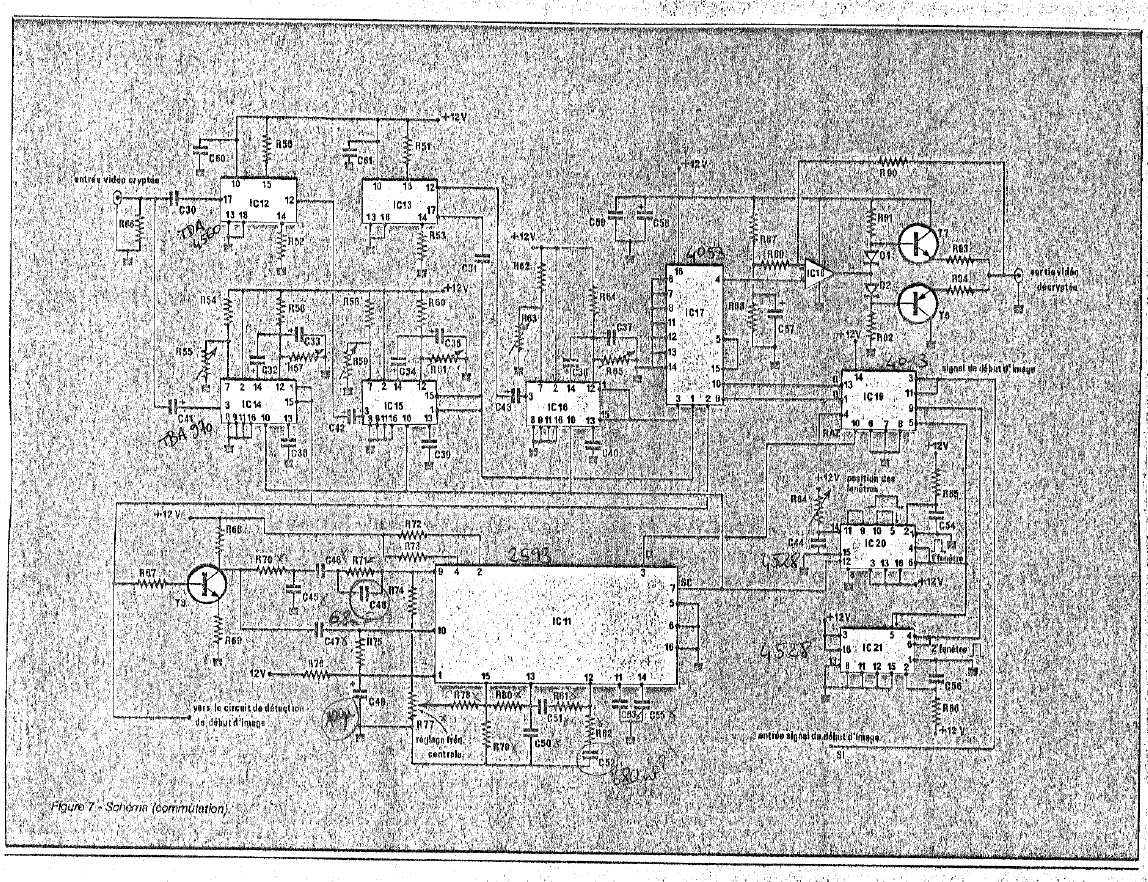
Discret11 keeps the delays, and also a quite similar sync extraction circuit as the one from the above schematic,however, the goal is to encrypt instead of decrypt, so the line detecting circuitry isn’t used. It’s replaced by frequency dividers, which divide the line frequency in subdivision, so the delayed picture appear every 2, 4, 8 lines, selectable using two rotary switches. The occurency of delayed lines can be set to random (with a circuit based on Random Gate from Yves Usson/Yusynth), in an attempt to reproduce the original encryption (a pseudo-random sequence of a length of 6 frames). The delay times, fixed on the base circuit, can be modified using potentiometers, which will delay the whole line but will also affect color the line (as the phase of the chrominance signal is delayed with the rest of the signal). A wipe between original, non delayed, signal and the delayed signal has been added. Two potentiometers adds glitch effects, with a switch to turn them off.
The project is now available assembled through the webshop.
DOCUMENTATION
– User Guide
– Build guide
– BOM
– Schematics
– Mouser BOM (does not include screws for enclosure)
#discret11 sur Instagram

💡 Discret 11 y su Impacto en la Te…
El sistema **Discret 11** fue un innovador método de encriptación desarrollado en Francia durante los años 80, diseñado específicamente para proteger las transmisiones de televisión.
Más contexto en norvik.tech 👆
#NorvikTech #DesarrolloSoftware #TechInnovation #Tecnologia #Software #WebDevelopment #Programacion #Discret11 #Encriptacion #TecnologiaDeBroadcast #HistoriaDeLaTecnologia #Algoritmos #SeguridadInformatica
Apr 26




Combines is now available, it is in stock and ready to ship on Syntonie website, and some units will be on their way to retailers soon! Demo video is up on Youtube (link in bio)
Combines is a triple analog combiner, aimed at combining two signals in various ways.
Each of the three channels features:
- AVG: average of the two inputs, (A+B)/2
- DIFF: difference of the two inputs, ((A-B)/2)+0.5)
- MIN: minimum of the two inputs, min(A, B)
- MAX: maximum of the two inputs, max(A, B)
- XOR: absolute of the difference of the two inputs, abs(A-B)
- MIX: mix of three of the above, scaled to 1V, different on each of the three channels
CH1: (AVG+DIFF+MIN)/3
CH2: (AVG+MIN+XOR)/3
CH3: (AVG+DIFF+XOR)/3
As the front panel suggests, Combines can be used to combine a horizontal and vertical triangle signals (like rectified ramps or oscillators), resulting in 2D shapes, represented on the outputs. Of course, the inputs are not limited to triangle waves, as any signals can be combined together, such as different wave shapes, as well as 2D shapes to create even more complex shapes or an external video signal.
It features 3 channels to allow for RGB processing, however the channels can be chained together as well, increasing the complexity of the resulting output.
Specs:
- 8HP
- 125mA +12V
- 0mA -12V
- 0mA +5V
- 42mm deep
Apr 16


Matrice is now available, it is in stock and ready to ship on Syntonie website, and some units will be on their way to retailers soon! Demo video is up on Youtube (link in bio)
Matrice is a 1x3 matrix mixer with its outputs normalized to three VCAs.
Used in a RGB processing context, just before the RGB encoder, the matrix section allows to reach a great variety of color palettes, especially when using matte/keyed shapes or posterizing.
The VCAs essentially works as a fade to black, allowing to tame the colors, which is especially useful after the matrix, since it can outputs signals up to 3V, as well as inverting them, that can result in a really bright composition.
Specs:
- 16HP
- 310mA +12V
- 0mA -12V
- 0mA +5V
- 42mm deep
Apr 16


Another quick patch with a similar setup as the previous video, but with ramps and 2D shapes from Rampes instead of an external video signal through Entrée. Recorded in 720p60.
Matrice is available as a pre-order on Syntonie website.
#videoart #videosynthesis #analogvideo #eurorack #syntonie
Mar 2


Synthesis patch made with Rampes, Combines, Seuils, Matrice and Sortie.
Various ramps, mirrored ramps and 2D shapes from Rampes are combined together using the three channels of Combines, outputs of Combines going to Seuils signal inputs and CV inputs to generate hard shapes/mattes, which are later processed through Matrice for color tuning using its matrix mixer, and its triple VCA to cut through the colors/creating negative space, finally outputs of Matrice are encoded with Sortie in 720p60.
#videoart #analogvideo #videosynthesis #eurorack #syntonie
Feb 25

Building a proof-of-concept RPi frame sampler w. cyberboy666 ! Records ~30 seconds NTSE 24bit video when GPU split is set to 128MB - with some additional #discret11 for effect. Code up on http://github.com/autr/rpi-frame-sampler #raspberrypi #openframeworks #videocircuits #videosynth
Mar 12


